


Masks in Motion at HUACUI Contemporary Art Museum
Shanghai, from August 1–31, 2026.
Invited to Shanghai for an artist residency at HUACUI Contemporary Art Museum, Henrique “EDMX” Montanari immersed himself in the city’s cultural landscape while developing a new body of work that culminated in the exhibition Masks in Motion.
Curated by Huang Yi, the exhibition brought Montanari’s work into dialogue with Chinese contemporary artist Gong Xinru, exploring identity, social behavior, and the different “masks” people adopt within contemporary urban life.
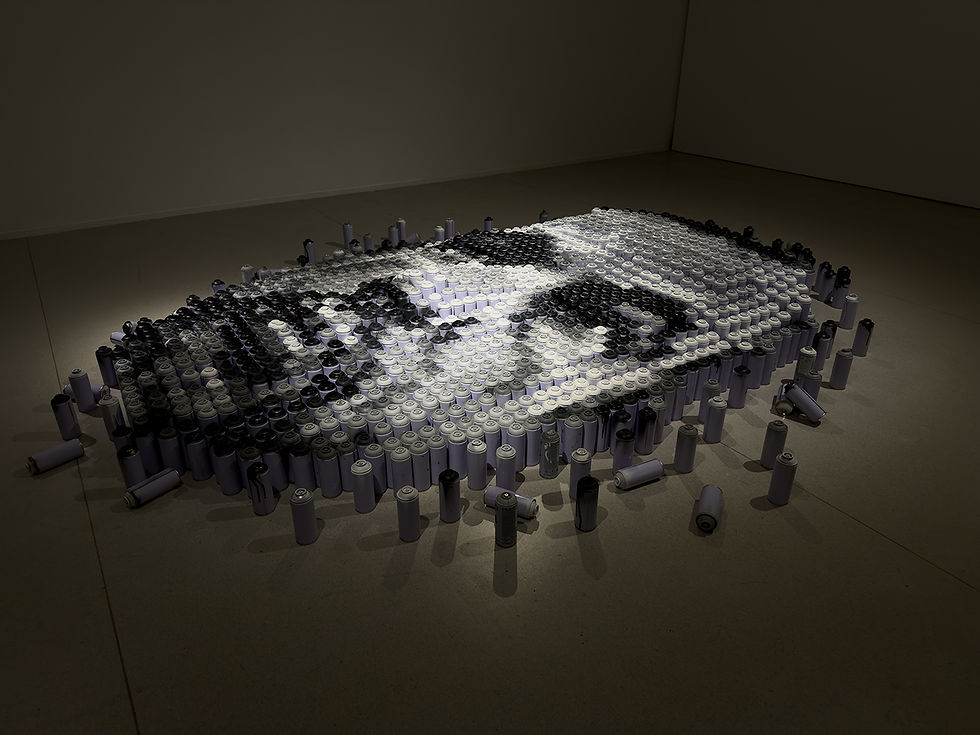
During the residency, Montanari developed new works connecting his background in street art with his ongoing investigation into digital culture and materiality. His practice transforms discarded spray cans into physical pixels, creating large-scale portraits and installations that translate digital image logic into physical space.
The residency became an exchange between Brazil and China, bringing together urban art, contemporary practice, analog materials, and digital systems while exploring how technology and contemporary society influence the ways we construct and reveal our identities.


10th Beijing International Art Biennale - Beijing Exhibition Centre, China
29 December 2025 – 28 February 2026 (Extended)

Brazilian interdisciplinary artist Henrique Montanari presents 780 SPI at the 10th Beijing International Art Biennale — an immersive sculptural installation composed of 780 recycled spray cans, expanded through augmented reality.
Developed through his signature SPI (Spray-Pixel Illusion) methodology, 780 SPI transforms discarded spray cans into a three-dimensional portrait system. Each can functions as a physical pixel — once a tool of expression, now reconfigured into a modular architecture of image, memory and residue.
Presented under the Biennale theme “Coexistence,” the work examines the interdependence between humanity, environment and technological systems. Within this framework, 780 SPI reframes waste not as an endpoint, but as material potential — a transitional state between consumption and regeneration.
Through augmented reality, the physical sculpture extends beyond its material limits. Digital layers emerge from the surface of the cans, activating movement, transformation and ephemeral states of the portrait. The viewer encounters a dual reality — where matter and code coexist, and where the analog structure becomes a portal to an evolving digital dimension.
780 SPI ultimately operates between permanence and flux, physical presence and virtual expansion — embodying coexistence not only as theme, but as lived experience.

